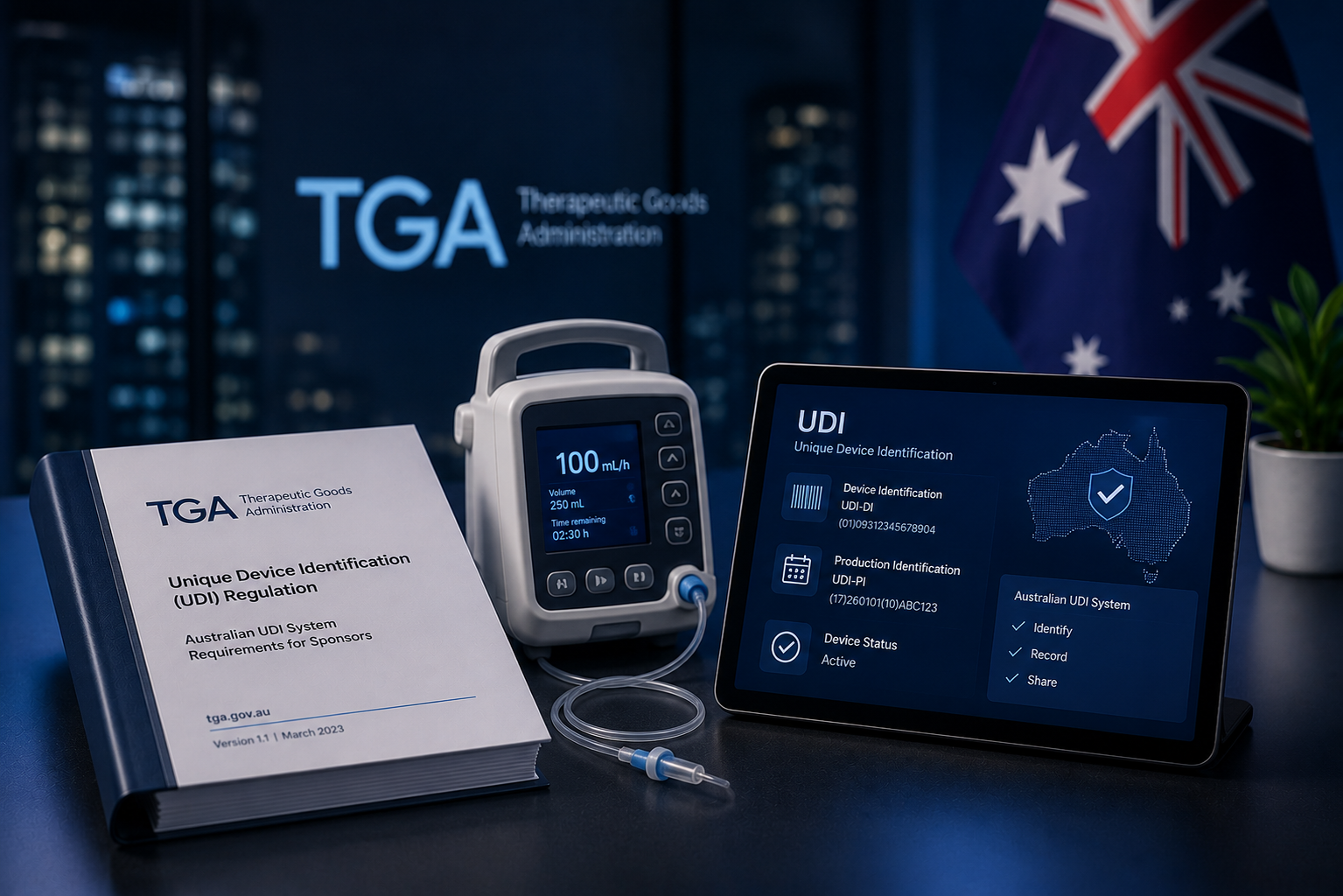


Australia’s UDI Requirements Are Now in Effect
As of 1 July 2026, Australia has officially entered the next phase of its Unique Device Identification (UDI) program. Mandatory UDI requirements now apply to Class III and Class IIb medical devices supplied in Australia, including both UDI labelling requirements and submission of device information to the Australian Unique Device Identification Database (AusUDID).
For manufacturers supplying products into the Australian market, this represents more than another regulatory deadline. It marks the beginning of an ongoing obligation to maintain accurate UDI data throughout the product lifecycle.
Organizations that have not yet established their AusUDID submission processes should act quickly, while those already complying should focus on building scalable processes that support ongoing regulatory operations.
What Changed on 1 July 2026?
Beginning 1 July 2026, manufacturers and Australian sponsors of applicable higher-risk medical devices must comply with Australia’s UDI requirements.
For devices within scope, organizations must:
- Apply compliant UDI labelling to applicable devices and packaging
- Submit required UDI-Device Identifier (UDI-DI) information to AusUDID
- Maintain accurate device information over time
- Update regulatory data whenever required
- Support ongoing traceability throughout the device lifecycle
Australia’s UDI program has been designed to improve medical device traceability, strengthen post-market surveillance, support recalls, and improve transparency for healthcare providers and patients.
Australia’s UDI Program Is Being Rolled Out in Phases
The July 2026 milestone applies primarily to Class III and Class IIb medical devices.
Lower-risk devices will follow under Australia’s phased implementation schedule:
| Device Classification | Mandatory UDI Compliance |
|---|---|
| Class III & Class IIb | 1 July 2026 |
| Class IIa | 1 July 2027 |
| Class Is and certain additional device categories | From 2028, depending on device type and applicable transitional arrangements |
Manufacturers with broad product portfolios should begin preparing well before their applicable deadlines to avoid a compressed implementation timeline.
AusUDID Is Closely Connected to ARTG Registration
Unlike some other global UDI databases, Australia’s implementation requires close alignment between AusUDID records and the Australian Register of Therapeutic Goods (ARTG).
This means manufacturers and Australian sponsors must ensure:
- Device information is consistent across regulatory systems
- UDI records accurately align with ARTG entries
- Product updates remain synchronized over time
- Regulatory changes are reflected promptly within AusUDID
Maintaining this consistency becomes increasingly important as product portfolios expand and device information changes throughout the product lifecycle.
Manual Submission Processes Don’t Scale
Many organizations begin their Australian UDI journey using spreadsheets, manual file preparation, or portal-based submissions.
While manageable for a small number of products, these approaches quickly become difficult when organizations need to:
- Manage thousands of device records
- Aggregate data from ERP, PLM, PIM, MDM, and regulatory systems
- Maintain ARTG alignment
- Correct data validation errors
- Process ongoing product changes
- Monitor submission status
- Support multiple regulatory markets simultaneously
For global manufacturers already managing FDA GUDID, EUDAMED, and other regulatory databases, maintaining separate manual processes for Australia significantly increases operational complexity.
Trusted Product Data Is the Foundation for AusUDID Compliance
Successful AusUDID submissions depend on timely, governed and validated product data.
Common challenges include:
- Missing mandatory attributes
- Inconsistent UDI information across systems
- Incorrect packaging hierarchies
- Data discrepancies between enterprise systems and regulatory submissions
Organizations with strong product data governance can generally adapt more quickly to regulatory changes while reducing submission errors and ongoing maintenance effort.
Manufacturers Are Increasingly Automating UDI Data Submissions
As Australia’s UDI requirements mature, many manufacturers are moving away from manual submission methods toward automated UDI data management, validation and submission processes.
Modern and reliable UDI submission solutions help organizations:
- Integrate with ERP, PLM, PIM, MDM, and regulatory systems
- Validate data before submission
- Apply the latest AusUDID business rules
- Support machine-to-machine (M2M) submission as capabilities continue to evolve
- Track submission status and acknowledgements
- Maintain complete audit history
- Reuse trusted product data across multiple global UDI databases
Rather than replacing existing product data systems, these solutions extend them with UDI-specific data validation, transformation, and submission capabilities.
Australia Is Part of a Growing Global UDI Landscape
Australia joins a growing number of regions implementing standardized UDI requirements to improve medical device traceability and patient safety.
For manufacturers operating globally, this creates an opportunity to establish a centralized regulatory submission strategy that supports multiple jurisdictions, including:
- Australia (AusUDID)
- European Union (EUDAMED)
- United States (GUDID)
- Switzerland (swissdamed)
- Additional global UDI programs as they become operational
Organizations that build scalable submission processes today will be better positioned as global regulatory requirements continue to expand.
Questions Manufacturers Should Be Asking
Now that Australia’s mandatory UDI requirements have begun, manufacturers should evaluate whether they are prepared for ongoing compliance with evolving regulations.
Key questions include:
- Can we efficiently maintain AusUDID records as products change?
- Is our device data validated before submission?
- Are our ARTG and AusUDID records consistently synchronized?
- Can we quickly identify and resolve submission errors?
- Are our Australian processes integrated with our global UDI strategy?
- Can our current approach scale as additional device classes become subject to mandatory compliance?
Answering these questions can help identify opportunities to improve both regulatory compliance and operational efficiency.

Final Thoughts
The 1 July 2026 milestone marks an important step in Australia’s modernization of medical device regulation. For manufacturers supplying higher-risk medical devices, AusUDID is now an operational reality, and not a future initiative.
Organizations that invest in trusted product data, automated data validation, and scalable regulatory submission processes will be better equipped to meet Australia’s ongoing UDI requirements while supporting broader global compliance initiatives.
As more device classes become subject to mandatory UDI requirements over the coming years, manufacturers that establish efficient and repeatable regulatory processes today will be well positioned for long-term success.