

Introduction
The MDR and IVDR establish a comprehensive regulatory framework governing the identification, registration, traceability, and post-market surveillance of medical devices throughout the European Union. At the center of this framework is the Unique Device Identification (UDI) system, supported by EUDAMED as the central database for device information.
With the mandatory use of key EUDAMED modules now underway and manufacturers transitioning from preparation to ongoing compliance, regulatory teams must understand not only what the UDI requirements are, but also how the different components of the EU framework fit together. From identifier assignment and device labelling to EUDAMED registration and post-market surveillance, compliance depends on accurate, governed, and consistently maintained product data.
This article provides a practical overview of the EU UDI framework under MDR and IVDR, explaining the purpose of the regulations, the structure of the UDI system, stakeholder responsibilities, EUDAMED requirements, key compliance obligations, and the broader strategic value of establishing trusted product data for UDI compliance in the European market.
The Strategic Purpose of UDI under MDR and IVDR
The primary objective of MDR (2017/745) and IVDR (2017/746) was to address longstanding traceability gaps across the medical device industry. Under the previous directives, the absence of a harmonized identification system limited the ability of competent authorities to effectively monitor device safety and performance. The UDI system was introduced to establish standardized device identification and end-to-end traceability. Its key objectives are to:
- Enhance patient safety: Enable faster and more precise recalls by identifying affected devices through specific batch, lot, or serial numbers.
- Strengthen market surveillance: Improve regulators’ ability to monitor device performance, identify trends, and investigate adverse events.
- Mitigate counterfeiting: Support supply chain integrity by enabling device authenticity to be verified throughout distribution and use.
- Standardize global UDI data: Align the EU with International Medical Device Regulators Forum (IMDRF) guidance, promoting greater global consistency in device identification and regulatory data.
Scope and Stakeholder Obligations
A key feature of MDR and IVDR is their expanded regulatory scope. The requirements apply across a broad range of medical devices and in vitro diagnostic products, while also introducing new obligations for economic operators throughout the supply chain.
- MDR Scope: Covers all medical devices, from Class I products such as bandages to Class III implantable devices, as well as certain products without an intended medical purpose, including aesthetic lasers and dermal fillers listed under Annex XVI.
- IVDR Scope: Applies to a wide range of in vitro diagnostic devices, including reagents, calibrators, instruments, and software used to examine human specimens. IVDR also introduces a new risk-based classification system (Classes A–D), significantly increasing the number of devices requiring notified body involvement and UDI assignment.
The regulations also define responsibilities for economic operators. Manufacturers are primarily responsible for registering UDI data and ensuring compliant labelling, while importers and distributors must verify that devices meet applicable UDI requirements. Healthcare institutions are also required to record and retain UDI information for certain high-risk devices to support end-to-end traceability.
Key UDI Identifiers for MDR and IVDR Compliance
The EU UDI framework is designed to identify both a device model and its production-specific information, enabling complete traceability throughout the product lifecycle. It consists of several identifiers, each serving a distinct regulatory purpose.
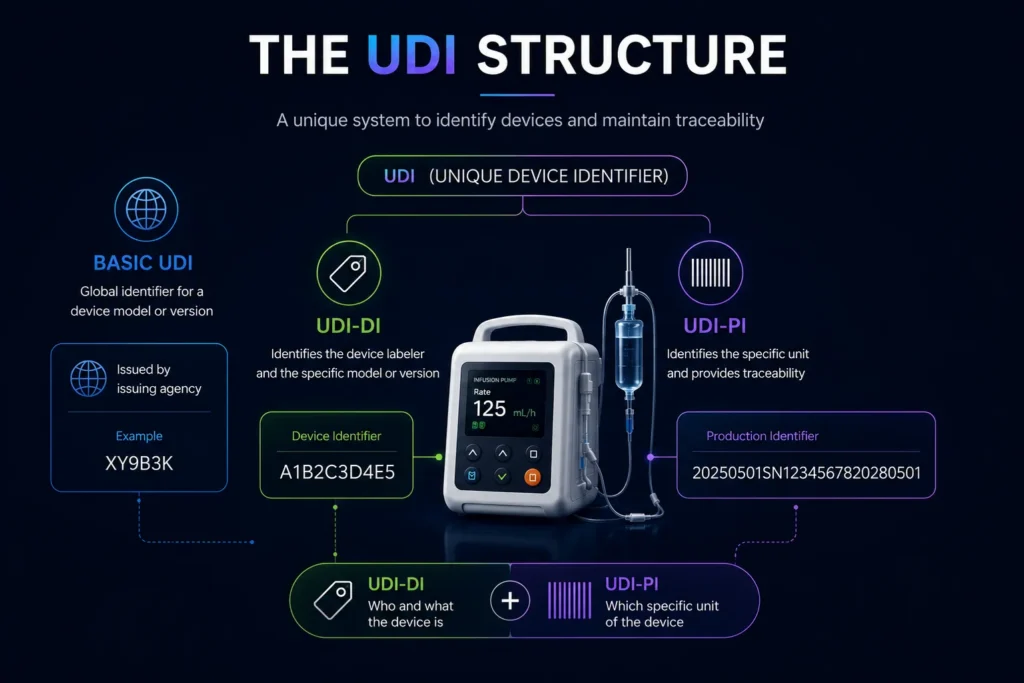
Basic UDI-DI (Model Identifier)
Unique to the EU regulatory framework, the Basic UDI-DI is the primary identifier used within EUDAMED and is referenced in certificates, declarations of conformity, and technical documentation. It does not appear on the device label. Instead, it groups devices that share the same intended purpose, risk class, and essential design and manufacturing characteristics, providing the regulatory link between a device family and its conformity assessment.
UDI-DI (Device Identifier)
The UDI-DI is the static portion of the UDI and uniquely identifies a specific device model from a manufacturer. It serves as the key identifier for device records within EUDAMED. Changes that affect device identification or traceability—such as a new trade name, device version, or sterile status—generally require assignment of a new UDI-DI.
UDI-PI (Production Identifier)
The UDI-PI is the dynamic portion of the UDI and identifies production-specific information. Depending on the device and applicable requirements, it may include:
- Lot or batch number
- Serial number
- Expiration date
- Software version
Together, the UDI-DI and UDI-PI form the complete UDI, which must be presented in both Human Readable Interpretation (HRI) and Automatic Identification and Data Capture (AIDC) formats, such as linear or two-dimensional barcodes.
Issuing Entities
UDI identifiers are assigned through EU-designated Issuing Entities, currently GS1, HIBCC, and ICCBBA. These organizations maintain the globally recognized standards used to generate unique device identifiers under MDR and IVDR.
EUDAMED UDI/Device Registration
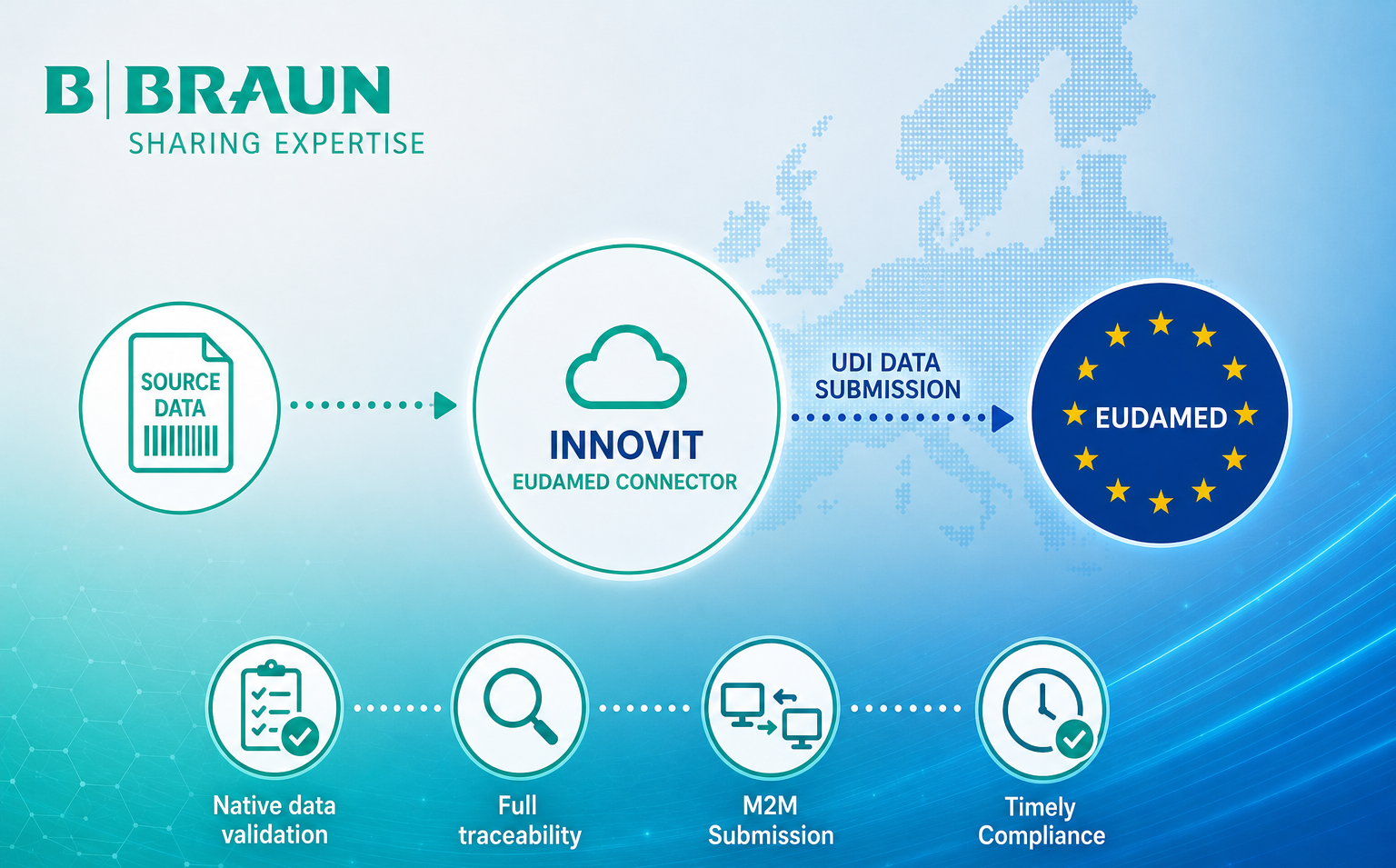
EUDAMED serves as the digital infrastructure supporting MDR and IVDR. While closely related, the UDI system and EUDAMED serve different regulatory functions. The UDI system establishes standardized identifiers that uniquely identify medical devices and support traceability throughout their lifecycle, while EUDAMED is the European Commission’s central regulatory platform that stores and manages the regulatory information associated with those identifiers.
EUDAMED enables manufacturers, notified bodies, competent authorities, and the European Commission to exchange standardized device information throughout the product lifecycle. Together, the UDI system and EUDAMED provide the foundation for device registration, market surveillance, vigilance reporting, and post-market regulatory oversight across the European Union.
The platform consists of six interconnected modules covering:
- Actor Registration
- UDI/Device Registration
- Notified Bodies and Certificates
- Clinical Investigations and Performance Studies
- Vigilance and Post-Market Surveillance
- Market Surveillance
For UDI compliance, manufacturers are required to register the Basic UDI-DI, UDI-DI, and associated device data within the UDI/Device Registration module before placing applicable devices on the EU market. These records include key device characteristics, regulatory classifications, certificates, and other mandatory data elements specified under MDR and IVDR.
| Regulatory Requirement | Applicability | Mandatory Date |
|---|---|---|
| UDI Assignment | MDR Devices | 26 May 2021 |
| UDI Assignment | IVDR Devices | 26 May 2022 |
| UDI Labelling | MDR (Risk-based implementation) | 2021–2025 |
| UDI Labelling | IVDR (Risk-based implementation) | 2023–2027 |
| Mandatory EUDAMED Registration (New MDR & IVDR Devices) | All Classes | 28 May 2026 |
| Legacy Device Registration | MDR & IVDR Transitional Devices | 28 November 2026 |

EUDAMED Registration
On 27 November 2025, the European Commission declared the Actor Registration, UDI/Device Registration, Notified Bodies and Certificates, and Market Surveillance modules fully functional, triggering the mandatory transition period established under Regulation (EU) 2024/1860. From 28 May 2026, these modules became mandatory, with manufacturers given an additional six months to register eligible legacy devices.
Data Governance Throughout the Device Lifecycle
UDI compliance extends well beyond assigning identifiers and completing an initial EUDAMED registration. Manufacturers must establish governance processes that ensure regulatory data remains accurate, consistent, and synchronized throughout the entire product lifecycle.
Effective lifecycle management includes:
- Identifier Management: Assigning and maintaining Basic UDI-DIs and UDI-DIs using an EU-designated Issuing Entity, while ensuring identifiers remain aligned with product changes.
- Regulatory Data Maintenance: Keeping EUDAMED records synchronized with product labelling, technical documentation, declarations of conformity, certificates, and internal source systems.
- Change Assessment: Evaluating product, manufacturing, packaging, or regulatory changes to determine whether updates to EUDAMED records are required or whether a new UDI-DI must be assigned.
- Labelling and Direct Marking: Applying compliant UDI carriers on labels and packaging, and implementing Direct Part Marking (DPM) where required for reusable devices.
- Post-Market Surveillance: Using relevant UDI identifiers consistently across vigilance reporting, field safety corrective actions (FSCAs), trend reporting, and other post-market activities.
Maintaining governed regulatory data throughout the device lifecycle reduces compliance risk, improves audit readiness, and supports efficient management of product changes across multiple regulatory jurisdictions.
Strategic Value Beyond Compliance
Although UDI is a regulatory requirement, it also establishes the foundation for trusted regulatory product data. Manufacturers that maintain governed UDI information benefit from improved traceability, more efficient regulatory operations, and greater consistency across technical documentation, product labelling, and regulatory submissions.
As additional markets adopt UDI frameworks based on similar international principles, mature data governance enables organizations to reuse trusted product information across multiple jurisdictions while reducing the effort required to support evolving regulatory requirements. Rather than viewing UDI as a one-time compliance initiative, manufacturers should treat it as an enterprise capability that supports long-term regulatory readiness and global market access.
Key Takeaway
The success of UDI compliance is ultimately determined by the quality of your product data. Manufacturers that invest in accurate, governed, and traceable device information will not only meet today’s MDR and IVDR requirements but also be prepared for the next generation of global regulatory compliance.