

Introduction
The Global Data Synchronization Network (GDSN) has become the global framework for exchanging standardized product data between trading partners. As organizations increasingly rely on accurate and up-to-date product information to support supply chain operations, procurement, eCommerce, and other critical business activities, GDSN provides a common framework for maintaining and publishing product data across the global trading community.
This article provides a high-level introduction to GDSN, explaining why it was established, how it works, the organizations involved, and the responsibilities, challenges, and best practices associated with participating in the network. Whether you are new to GDSN or looking to better understand it, this guide provides the foundational knowledge needed before exploring specific data pools, data pool connectors or implementation approaches.
Why GDSN Exists
As supply chains have become increasingly global and interconnected, organizations have become more dependent on accurate and standardized product data to support purchasing, logistics, eCommerce, supply chain, and other critical business operations. Historically, however, product data was often exchanged between trading partners using spreadsheets, emails, proprietary formats, and point-to-point integrations, resulting in inconsistent information, duplicate maintenance, and significant operational burden.
The Global Data Synchronization Network (GDSN) was established by GS1 to provide a standardized approach for publishing and synchronizing trusted product data between trading partners. Rather than maintaining multiple versions of product information for different customers or markets, organizations can publish standardized product data once and synchronize it with multiple recipients through certified data pools. This helps ensure that trading partners are working with the same accurate, consistent, and up-to-date product information.
The primary objectives of GDSN include:
- Standardizing the exchange of product data between trading partners
- Improving the accuracy, consistency, and completeness of product information
- Reducing manual data entry, duplicate maintenance, and synchronization errors
- Enabling efficient onboarding of products and trading partners
- Supporting greater supply chain interoperability and operational efficiency
- Providing trusted product data that supports procurement, logistics, inventory management, eCommerce, supply chain, and other downstream business activities
Today, GDSN is the world’s largest standards-based product data synchronization network, enabling organizations across multiple industries to exchange product information more efficiently while improving data quality, collaboration, and supply chain performance.
What is GDSN?
The Global Data Synchronization Network (GDSN) is a global network of interoperable, GS1-certified data pools that enables trading partners to exchange standardized product data using a common set of GS1 standards. It provides a consistent and reliable way for organizations to publish, synchronize, and maintain trusted product information across multiple trading partners and markets.
Unlike a centralized product database, GDSN is a distributed network that connects certified data pools around the world. Manufacturers and other data publishers maintain their product information within a certified data pool, while distributors, retailers, healthcare providers, and other data recipients subscribe to receive synchronized product data relevant to their business.
GDSN uses globally recognized GS1 identification standards, including Global Trade Item Numbers (GTINs) and Global Location Numbers (GLNs), together with standardized product attributes and business rules. This enables trading partners to exchange product information in a consistent format regardless of the systems or technologies they use internally.
Rather than simply transmitting product information, GDSN establishes a standardized framework for synchronizing product data throughout the product’s lifecycle. By ensuring all participating trading partners receive consistent and up-to-date information, GDSN improves data quality, reduces operational inefficiencies, and supports more effective collaboration across global supply chains.
How GDSN Works
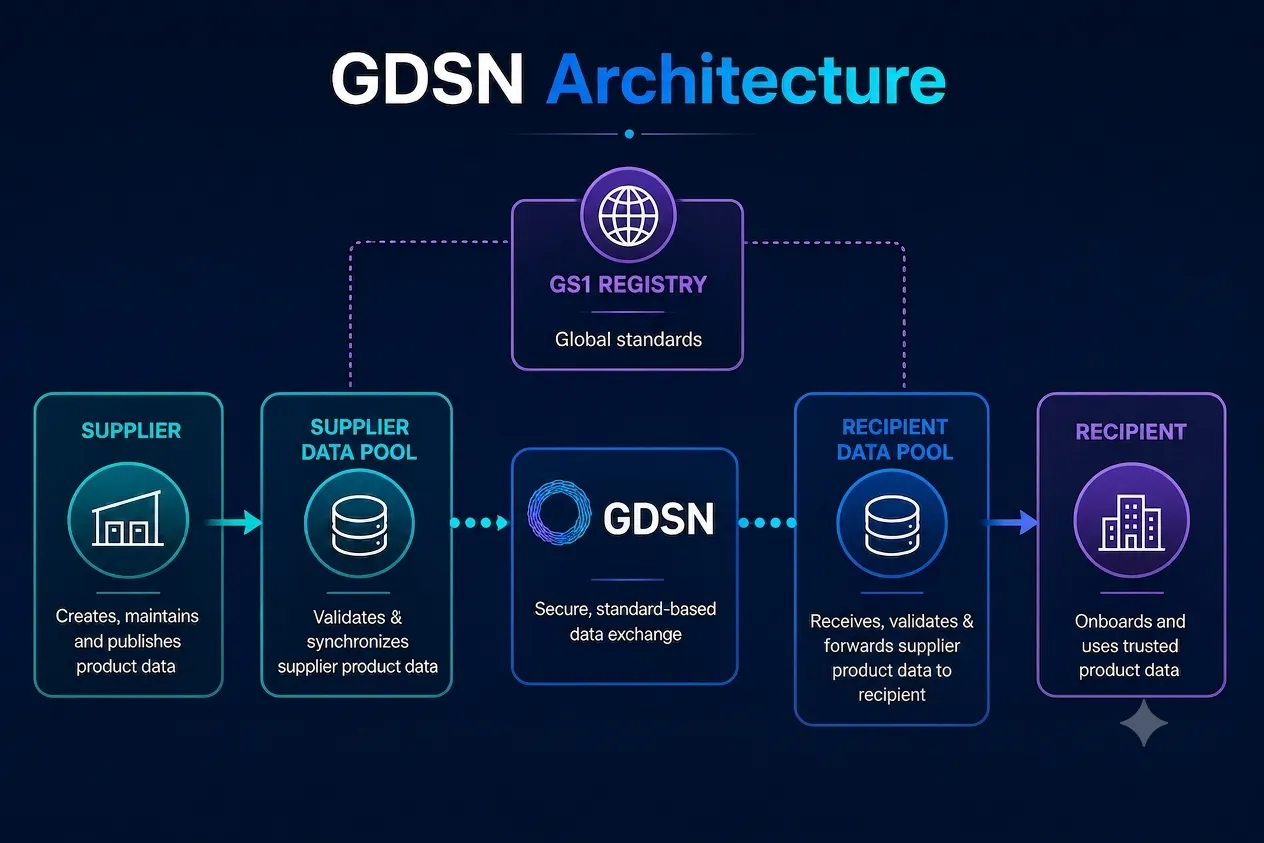
GDSN enables organizations to exchange standardized product data through a network of GS1-certified data pools. Rather than sending product information separately to each trading partner, organizations publish standardized product data once and synchronize it with authorized recipients through the network.
The core components of GDSN include:
- Global Trade Item Number (GTIN) – The Global Trade Item Number (GTIN) is the globally unique identifier used to identify products within GDSN. Each GTIN uniquely identifies a specific trade item, ensuring that all trading partners reference the same product consistently.
- Global Location Number (GLN) – The Global Location Number (GLN) uniquely identifies organizations and physical locations participating in GDSN. GLNs enable product data to be exchanged between the correct publishers and recipients while supporting accurate identification of companies, facilities, and business locations.
- Standardized Product Attributes – In addition to product identifiers, GDSN supports a standardized set of product attributes that describe each trade item, such as dimensions, weight, packaging, brand, classifications, and other supply chain information. These attributes are standardized through the GS1 Global Data Dictionary (GDD), which provides a common vocabulary and consistent definitions to help trading partners exchange product data accurately and interpret it consistently across different systems and industries.
- Certified Data Pools – Certified data pools are organizations authorized by GS1 to publish, receive, validate, and synchronize product data within the GDSN network. They provide the infrastructure that enables trading partners to exchange standardized product information while maintaining compatibility with other certified data pools worldwide.
- GS1 Global Registry – The GS1 Global Registry acts as a directory for the GDSN network. Rather than storing complete product records, it maintains key information that enables certified data pools to discover products and identify where authoritative product data is maintained, allowing trading partners to synchronize information efficiently.
- Publish and Subscribe – GDSN operates on a ‘publish and subscribe’ model. Data publishers maintain and publish standardized product information through a certified data pool, while authorized trading partners subscribe to the products they require. As product information is created or updated, changes are automatically synchronized across the network, helping ensure all subscribers receive accurate, consistent, and up-to-date product data.
Together, these components provide a standardized, scalable framework for exchanging trusted product information across global supply chains, enabling organizations to improve data quality, streamline collaboration, and reduce the operational effort required to maintain consistent product information.
The Global GDSN Ecosystem
GDSN is supported by a global ecosystem of standards organizations, certified data pools, and trading partners that work together to enable the standardized exchange of product data. Each participant plays a distinct role in ensuring product information is published, synchronized, and maintained consistently across the network.
| Organization | Primary Role | Examples |
|---|---|---|
| GS1 | Develops and maintains the global standards that underpin GDSN, including identification standards, data models, and business rules. | GS1 Global Office, GS1 Member Organizations |
| GS1 Global Registry | Serves as the central directory that enables certified data pools to discover products and identify where authoritative product data is maintained. | GS1 Global Registry |
| Certified Data Pools | Publish, receive, validate, and synchronize standardized product data between trading partners while maintaining interoperability across the GDSN network. | 1WorldSync, atrify, NPC, GHX |
| Data Publishers | Create, maintain, and publish standardized product data for the products they supply. | Manufacturers, Brand Owners, Suppliers |
| Data Recipients | Subscribe to and consume standardized product data to support business processes and maintain accurate product information within their internal systems. | Distributors, GPOs, Retailers, Healthcare Providers |
Together, these participants form the global GDSN ecosystem, enabling trusted product data to be exchanged efficiently and consistently between trading partners while reducing duplication, improving data quality, and enhancing supply chain efficiency.
Global Adoption of GDSN
GDSN has become the global standard for synchronizing trusted product data across a wide range of industries, including healthcare, food and beverage, retail, and consumer goods. Organizations around the world use GDSN to exchange standardized product data with trading partners more efficiently while improving data quality and operational efficiency.
While GDSN is built on globally recognized GS1 standards, certified data pools have evolved to support the specific needs of regional markets, industries, and trading communities. For example, NPC primarily serves Australia and New Zealand, GHX focuses on the healthcare sector, while atrify and 1WorldSync support trading partners across multiple international markets.
Although implementation requirements vary between industries and trading communities, organizations typically adopt GDSN to achieve common business objectives, including:
- Standardizing product information across trading partners
- Improving product onboarding and data synchronization
- Reducing manual data maintenance and operational inefficiencies
- Supporting interoperability between enterprise systems and supply chain partners
- Improving the quality and consistency of product information used across downstream business processes
As digital supply chains continue to evolve, organizations are increasingly adopting GDSN as the preferred approach for exchanging standardized product data. By leveraging globally recognized GS1 standards and certified data pools, trading partners can improve collaboration, streamline operations, and establish a trusted foundation for product data across increasingly interconnected supply chains.
GDSN Stakeholder Responsibilities
Successful participation in GDSN depends on collaboration between data suppliers, data recipients, and certified data pools. Each stakeholder has distinct responsibilities that help ensure product information remains accurate, standardized, and synchronized throughout the network.
| Stakeholder | Primary Responsibilities |
|---|---|
| Data Suppliers | Create, maintain, and publish accurate, complete, and standardized product data. Assign and manage GS1 identifiers (such as GTINs and GLNs), validate product information against GS1 standards, publish updates through a certified data pool, and maintain product data throughout the product lifecycle. |
| Data Recipients | Subscribe to relevant product information, validate synchronized data against business and trading partner requirements, review updates, and communicate acceptance, discrepancies, corrections, or requests for additional information through GDSN processes such as Catalogue Item Confirmation (CIC). |
| Certified Data Pools | Validate published product data, facilitate the publication, subscription, and synchronization of product information between trading partners, maintain interoperability with other GS1-certified data pools, and help ensure compliance with GS1 standards and GDSN business rules. |
Together, these stakeholders help establish and maintain a trusted product data ecosystem that enables consistent, reliable, and efficient product information exchange across the global supply chain.
Common GDSN Challenges
Although GDSN provides a standardized framework for product data synchronization, organizations often encounter practical challenges when publishing, maintaining, and consuming product information via GDSN. These challenges typically stem from data quality, governance, system integration, and the need to meet the requirements of multiple trading partners and data pools.
Common challenges include:
- Product Data Quality – GDSN depends on accurate, complete, and standardized product data. However, product information is often fragmented across ERP, PLM, Supply Chain and other enterprise systems, making it difficult to establish a single and trusted source of GDSN data.
- Data Governance and Ownership – Maintaining high-quality product information requires clear ownership, stewardship, and governance across multiple business functions. Without well-defined processes for managing changes, organizations can struggle to maintain complete and consistent product data for synchronization via GDSN.
- Trading Partner Requirements – While GDSN is based on GS1 standards, trading partners may have additional attribute requirements, data validation rules, or onboarding processes. Meeting these varying expectations while maintaining standardized product data can increase operational complexity.
- Regional Data Pool Requirements – Although GDSN operates as a global network based on common GS1 standards, certified data pools have evolved to support specific regions, industries, and trading communities. As a result, organizations operating globally often need to publish product data through multiple data pools to meet the requirements of different markets and trading partners. Managing multiple connections, onboarding processes, and publication workflows can increase operational complexity without an effective global data syndication strategy.
As organizations expand their product portfolios, target markets, and trading partner networks, addressing these challenges becomes increasingly important to maintaining trusted product data and realizing the full benefits of GDSN.
GDSN Best Practices
Successful GDSN participation depends on maintaining trusted product data over time. As product portfolios, trading partner relationships, and business requirements evolve, organizations need effective governance, standardized processes, and scalable technology to ensure product information remains accurate and synchronized.
The following best practices help establish a strong foundation to realize the full benefit of GDSN:
- Establish Strong Data Governance – Define clear ownership for product data across Product Management, Master Data Management, Supply Chain, Commercial Operations, and other stakeholders. Effective governance helps ensure product information remains accurate, consistent, and aligned across the organization.
- Build a Trusted Product Data Foundation – Maintain a single, reliable source of product data wherever possible. A trusted product data foundation improves consistency across enterprise systems, reduces duplication, and supports accurate synchronization with trading partners.
- Standardize Product Data – Adopt GS1 standards for identifiers, product attributes, and business processes to improve data quality, simplify product onboarding, and enable consistent product information exchange across multiple trading partners.
- Validate Data Before Publication – Validate product information against GS1 standards, certified data pool requirements, and trading partner expectations before publication. Early validation reduces synchronization errors, minimizes rework, and improves overall data quality.
- Automate Data Synchronization – Reduce reliance on manual data entry, spreadsheets, and repetitive processes by automating data validation, publication, and synchronization wherever appropriate. Automation improves efficiency while helping maintain consistent product information across multiple trading partners.
- Design for Global Scalability – Develop processes and technology that support publishing through multiple GS1-certified data pools and accommodate evolving regional and trading partner requirements. A scalable approach enables organizations to expand into new markets while maintaining a consistent global product data strategy.
Successful GDSN programs deliver benefits beyond product data synchronization. By strengthening data governance, improving data quality, and establishing standardized processes, organizations create a trusted product data foundation that supports more efficient collaboration, streamlined supply chain operations, and greater interoperability across the global trading community.

Key Takeaway
Successful GDSN participation is built on trusted product data, strong governance, and standardized synchronization processes. Organizations that establish these foundations will be better positioned to collaborate with trading partners, improve data quality, and support efficient product data syndication across global supply chains.