

Introduction
Unique Device Identification (UDI) has become one of the most significant global regulatory initiatives affecting the medical device industry. As regulatory authorities continue to strengthen requirements for product identification, traceability, and data quality, organizations are increasingly expected to manage standardized device information throughout the product lifecycle.
This guide provides a high-level introduction to UDI, explaining why it was established, how it works, the organizations involved, and the responsibilities and challenges associated with compliance. Whether you are new to UDI or looking to better understand the global regulatory landscape, this guide provides the foundational knowledge needed before exploring the specific implementation requirements of individual jurisdictions.
Why UDI Exists
Medical devices play a critical role in patient care, yet historically there was no globally consistent way to identify individual devices across manufacturers, healthcare providers, distributors, and regulators. Different organizations often relied on proprietary product numbers and local cataloging systems, making it difficult to trace products accurately throughout the healthcare supply chain.
The Unique Device Identification (UDI) system was introduced to establish a standardized approach for identifying medical devices throughout their lifecycle. By assigning every regulated device a unique, globally recognized identifier, UDI improves the accuracy, consistency, and transparency of device information across the healthcare ecosystem.
The primary objectives of UDI include:
- Improving patient safety through accurate device identification
- Supporting faster and more targeted product recalls
- Enhancing post-market surveillance and adverse event reporting
- Increasing supply chain traceability and inventory visibility
- Promoting consistent product identification across global markets
Today, UDI forms an essential foundation for modern medical device regulation and is becoming an increasingly important component of digital healthcare infrastructure worldwide.
What is UDI?
Unique Device Identification (UDI) is an international framework that establishes a standardized approach to identifying medical devices throughout the healthcare ecosystem. While many regulatory authorities have adopted common principles based on guidance from the International Medical Device Regulators Forum (IMDRF), each jurisdiction maintains its own regulatory requirements, implementation timelines, and regulatory databases.
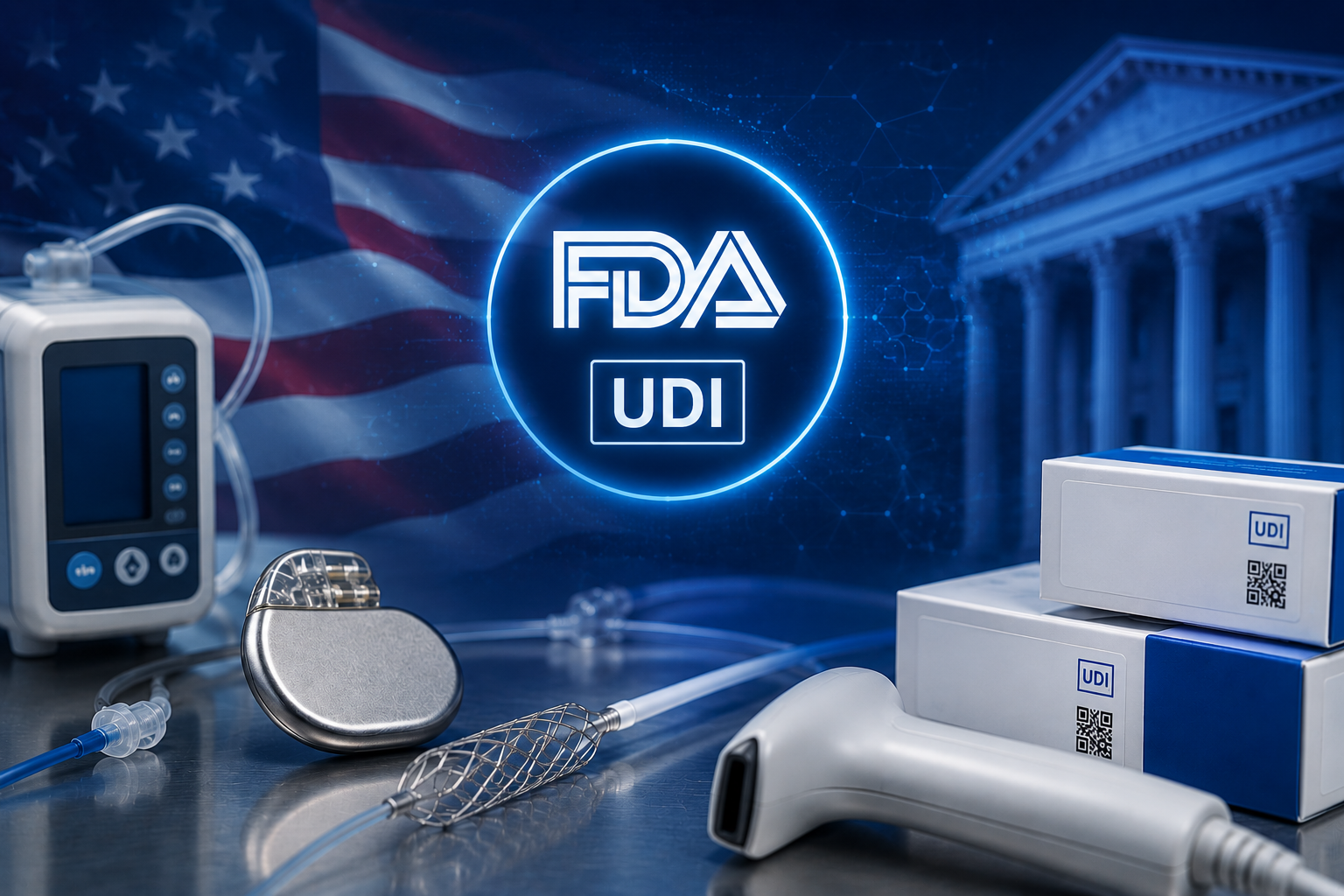
Under the UDI framework, manufacturers assign a unique identifier to each medical device using standards developed by accredited issuing agencies such as GS1, HIBCC, or ICCBBA. The identifier is applied to the device label in both machine-readable and human-readable formats and is linked to standardized product information submitted to the applicable regulatory UDI database.
Although often associated with barcodes, UDI encompasses far more than product labeling. It provides the standardized identification and product information that enable regulators, manufacturers, healthcare providers, and supply chain organizations to consistently identify, trace, and manage medical devices throughout their lifecycle.
How UDI Works
Every UDI consists of standardized components that uniquely identify both the medical device itself and, where required, the specific production details of an individual unit.
- Device Identifier (DI) – The Device Identifier is the fixed portion of the UDI. It identifies the manufacturer and the specific version or model of the medical device. The DI serves as the primary identifier referenced within regulatory databases and remains unchanged unless a new device identifier is required under applicable regulations.
- Production Identifier (PI) – The Production Identifier is the variable portion of the UDI and may include information such as:
- Lot or batch number
- Serial number
- Manufacturing date
- Expiration date
- UDI Carrier – The complete UDI (Device Identifier + Production Identifier) is placed on the device label and applicable packaging using an approved data carrier, typically a linear barcode or two-dimensional DataMatrix barcode. Some jurisdictions also permit additional technologies such as RFID in specific use cases.
- Human Readable Interpretation (HRI) – In addition to the machine-readable carrier, the UDI must generally be presented in plain text to allow manual identification when scanning is unavailable.
Together, these components enable healthcare providers, regulators, manufacturers, and supply chain organizations to consistently identify medical devices throughout distribution, clinical use, and post-market activities.

The Global Regulatory Ecosystem
UDI is supported by a broader regulatory ecosystem involving international organizations, regulatory authorities, accredited issuing agencies, and the organizations responsible for complying with UDI requirements. Although many jurisdictions have drawn on guidance from the International Medical Device Regulators Forum (IMDRF), each has developed its own regulations, implementation approach, and terminology for the organizations responsible for meeting UDI obligations.
| Organization | Primary Role | Examples |
|---|---|---|
| International Medical Device Regulators Forum (IMDRF) | Develops the foundational guidance and principles for UDI that many jurisdictions use when developing their own regulations. | IMDRF |
| Regulatory Authorities | Establish legal UDI requirements, define submission obligations, and operate national or regional UDI databases. | FDA (US), European Commission (EU), TGA (Australia), Swissmedic (Switzerland) |
| Accredited Issuing Agencies | Develop and maintain the identification standards used by responsible organizations to generate valid UDIs. | GS1, HIBCC, ICCBBA |
| Responsible Organizations | Assign UDIs, apply compliant labeling, submit required product information, and maintain compliance with applicable UDI regulations. Depending on the jurisdiction, this responsibility may rest with the manufacturer, labeler, sponsor, or another designated economic operator. | Manufacturers (EU, Switzerland), Labelers (US), Sponsors (Australia) |
Together, these organizations form the regulatory ecosystem that supports standardized medical device identification while enabling each jurisdiction to implement UDI according to its own regulatory requirements.
Global Implementation of UDI
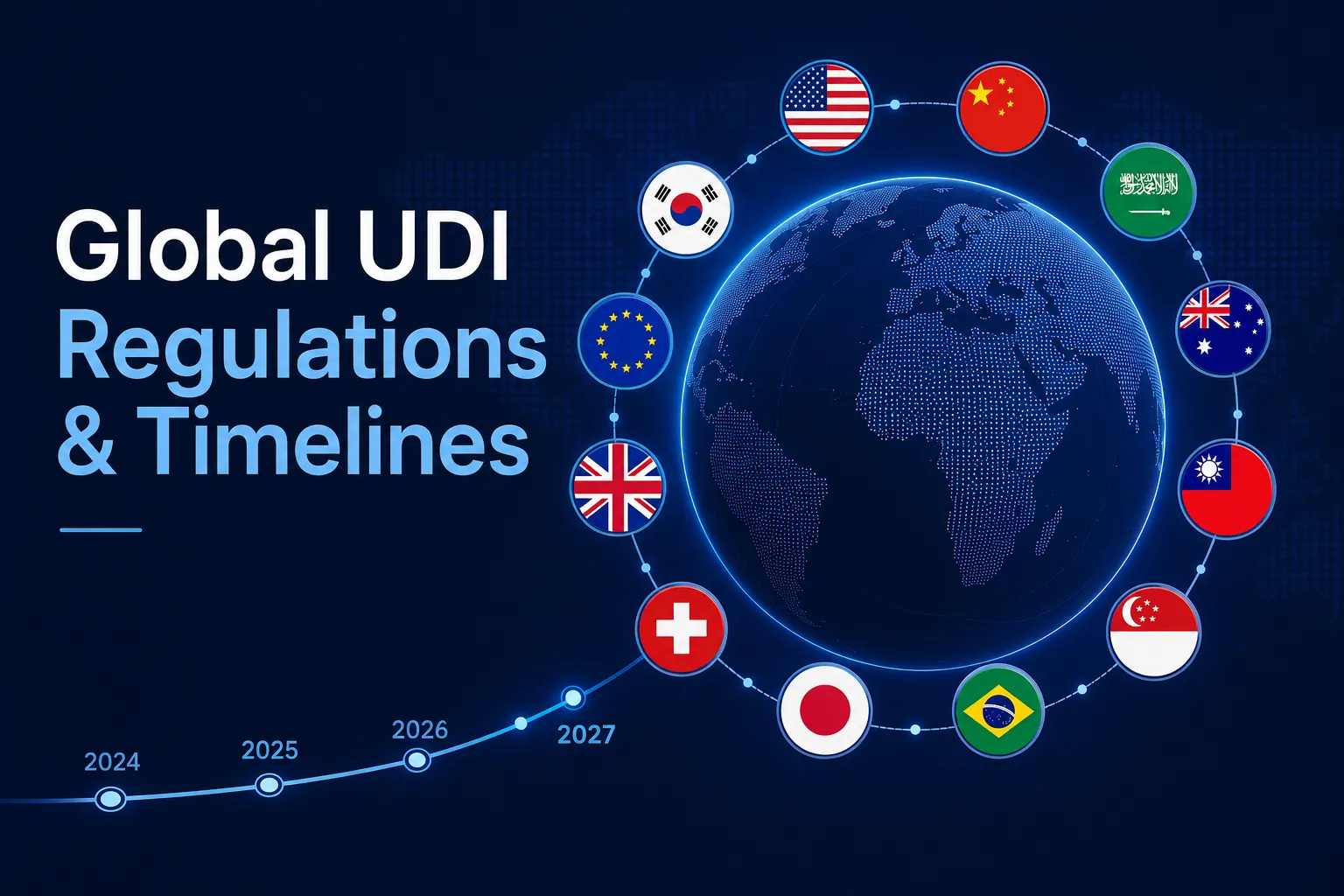
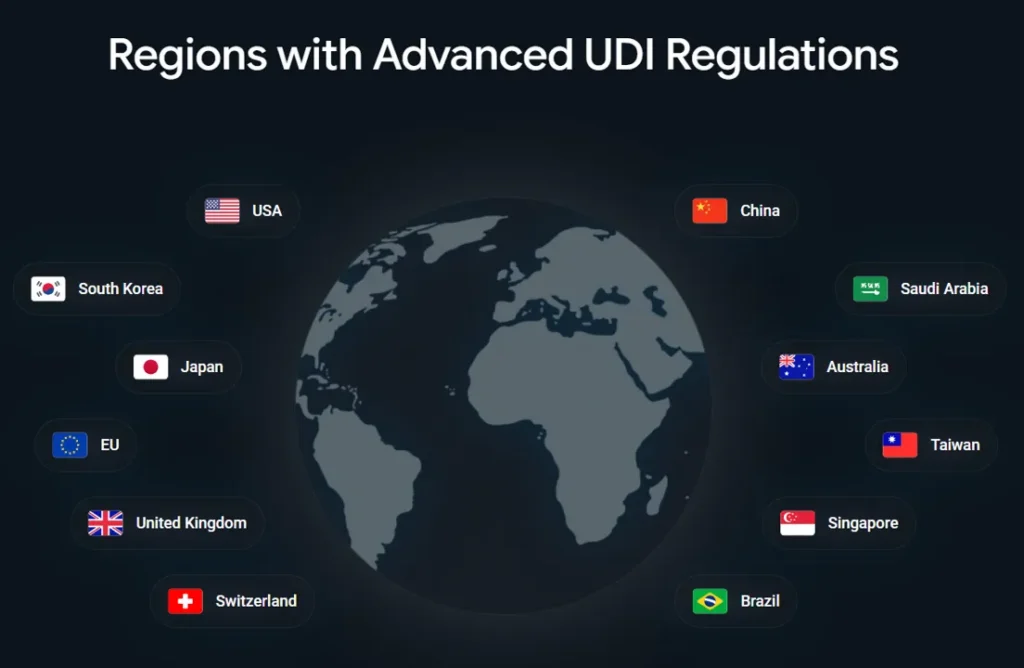
UDI has evolved into a global regulatory initiative, with many countries implementing national requirements based on the IMDRF UDI has become a global regulatory initiative, with an increasing number of jurisdictions implementing regulatory requirements for standardized medical device identification. While many have drawn on guidance developed by the International Medical Device Regulators Forum (IMDRF), each has established its own regulations, implementation timelines, and regulatory infrastructure.
Major markets, including the United States, European Union, Australia, and Switzerland, have established regulatory databases that maintain standardized device information submitted by the organizations responsible for UDI compliance. Other jurisdictions, including China, South Korea, Saudi Arabia, Singapore, and additional markets, continue to expand or introduce their own UDI programs.
Although implementation varies between jurisdictions, most UDI systems share several common characteristics:
- Use of accredited issuing agencies to generate compliant UDIs
- Standardized device identifiers applied to medical devices
- UDI labeling requirements for devices and applicable packaging
- Submission of standardized product information to regulatory databases
- Ongoing maintenance of device information throughout the product lifecycle
As UDI adoption continues to expand globally, organizations responsible for compliance must increasingly manage multiple regulatory frameworks simultaneously. Rather than treating each market as an independent initiative, many are adopting global product data governance strategies that support consistent, scalable compliance across jurisdictions.
UDI Compliance Key Responsibilities
UDI compliance extends beyond generating a device identifier or printing a barcode on a product label. The organization responsible for UDI compliance—whether defined by a jurisdiction as the manufacturer, labeler, sponsor, or another designated economic operator—is responsible for ensuring that device information remains accurate, complete, and up to date throughout the product lifecycle.
Although specific obligations vary between jurisdictions, responsible organizations are generally expected to:
- Assign compliant Unique Device Identifiers (UDIs)
- Apply UDI carriers to device labels and applicable packaging
- Submit required and compliant device data to the appropriate UDI database
- Update regulatory records when device information changes
- Maintain ongoing compliance throughout the product lifecycle
Successful UDI compliance requires collaboration across multiple business functions. Regulatory Affairs, Quality, Product Management, Labeling, Manufacturing, Supply Chain, and Information Technology all play important roles in ensuring product information is accurate, consistent, and maintained in accordance with applicable regulatory requirements.
Common UDI Challenges
Although the objectives of UDI are consistent across jurisdictions, organizations frequently encounter practical challenges when implementing and maintaining compliance. These challenges typically stem from differences in regulatory requirements, the complexity of managing product information, and the need to coordinate processes across multiple business functions and systems.
Common challenges include:
- Regulatory Complexity – Although many jurisdictions share common UDI principles, each has its own regulations, implementation timelines, submission requirements, and regulatory databases. Organizations operating globally must continually adapt to evolving requirements while maintaining compliance across multiple markets.
- Product Data Quality – UDI depends on accurate, complete, and consistent product information. However, required data is often fragmented across ERP, PLM, PIM, regulatory, and other enterprise systems, making it difficult to establish a single, trusted source of UDI data.
- Operational Coordination – Successful UDI programs require coordination between Regulatory Affairs, Quality, Labeling, Manufacturing, Supply Chain, and IT. Without clearly defined ownership, governance, and change management processes, maintaining consistent and compliant device information becomes increasingly difficult.
- Technology and Scalability – Manual processes, spreadsheets, and disconnected systems may be sufficient for small product portfolios but become difficult to sustain as product portfolios grow, organizations expand into new markets and regulatory requirements continue to evolve. A scalable UDI compliance platform becomes increasingly important for supporting long-term compliance.
UDI Best Practices
Organizations that successfully implement UDI recognize that compliance is not a one-time project but an ongoing operational capability. As regulatory requirements evolve and product portfolios expand, maintaining accurate product information, effective governance, and repeatable processes becomes increasingly important.
The following practices help establish a strong foundation for sustainable UDI compliance:
- Establish Strong Data Governance – Define clear ownership for product data across Regulatory Affairs, Quality, Product Management, Supply Chain, and other stakeholders. Well-defined governance, stewardship, and change management processes help ensure product information remains accurate, consistent, and aligned across the organization.
- Build a Trusted Product Data Foundation – Maintain a single, reliable source of product information wherever possible. Standardized product data improves consistency across internal systems, supports regulatory submissions, and reduces duplication and conflicting information.
- Standardize Data and Business Processes – Adopt standardized data models, terminology, and business processes to improve consistency, simplify regulatory submissions, and support compliance across multiple jurisdictions.
- Validate Data Before Submission – Implement validation processes that identify incomplete, inconsistent, or non-compliant product information before submission. Early validation reduces submission errors, minimizes rework, and helps maintain data quality over time.
- Automate Where Appropriate – Reduce reliance on manual data entry, spreadsheets, and repetitive tasks by leveraging appropriate automation for data validation, workflow, and regulatory submissions. Automation improves efficiency while reducing the risk of human error.
- Design for Global Scalability – Develop systems and processes that can accommodate new regulatory requirements, additional markets, and expanding product portfolios without requiring significant redesign. A scalable approach enables organizations to respond more efficiently as global UDI adoption continues to evolve.
Successful UDI programs deliver benefits beyond regulatory compliance. By strengthening product data governance, improving data quality, and establishing repeatable operational processes, organizations create a foundation that supports regulatory readiness, operational efficiency, and long-term adaptability in an increasingly complex global regulatory environment.
The Future of UDI
UDI is continuing to evolve as governments expand regulatory requirements, additional jurisdictions introduce national UDI programs, and healthcare systems place greater emphasis on trusted and up-to-date product information. What began as a regulatory initiative is increasingly becoming part of the broader digital transformation of healthcare.
Several trends are expected to shape the future of UDI:
- Continued global adoption, with more countries implementing UDI regulations and expanding existing programs.
- Greater regulatory convergence, as jurisdictions continue to align around common UDI principles while maintaining their own implementation requirements.
- Improved interoperability, enabling more consistent exchange of product information between manufacturers, regulators, distributors, healthcare providers, and other stakeholders.
- Enhanced post-market surveillance, supported by more accurate device identification and improved traceability throughout the product lifecycle.
- Greater reliance on high-quality product data, as standardized device information becomes increasingly integrated into regulatory, clinical, and supply chain systems.
As these trends continue, organizations will need to move beyond viewing UDI solely as a compliance obligation. Establishing strong product data governance, scalable processes, and flexible technology will help organizations adapt to evolving regulations while supporting broader business and operational objectives.

Key Takeaway
Successful UDI compliance is built on trusted product data, strong governance, and scalable processes. Organizations that establish these foundations will be better positioned to support global regulatory compliance today while adapting to the evolving UDI landscape of tomorrow.